
Hydraulic Vertical Lift for Heavy-Duty Material Handling Applications
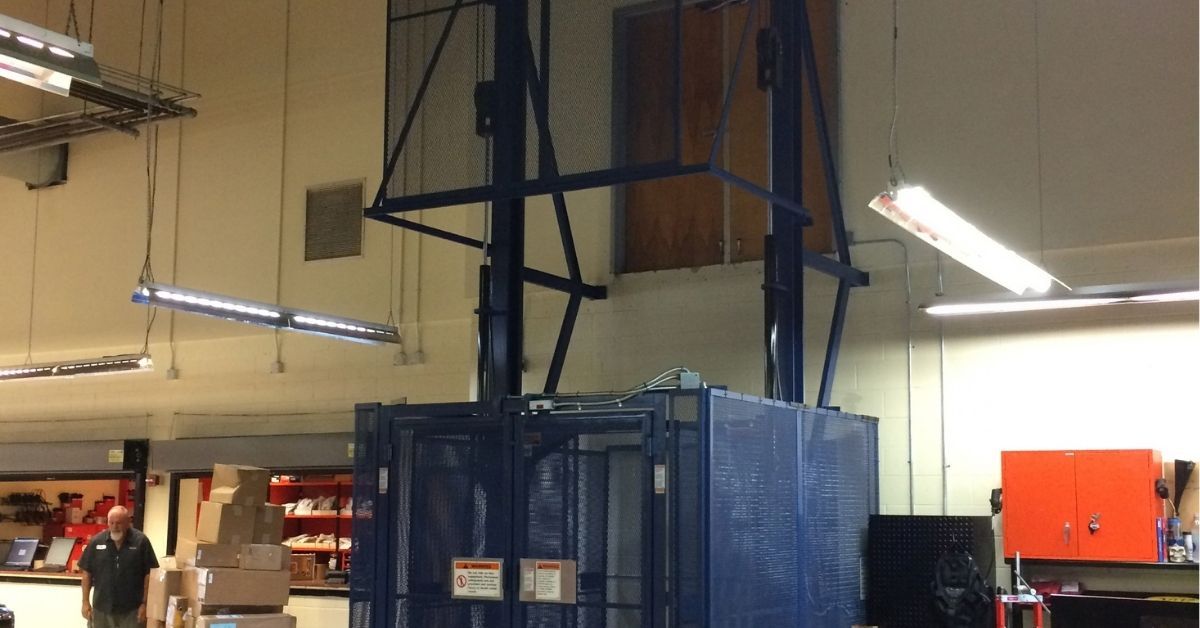


Selecting a Hydraulic Vertical Lift: A Practical Guide for Industrial Applications
Moving heavy loads vertically creates different challenges than standard horizontal material handling. You can’t just add a conveyor or extend a floor, you need a solution designed specifically for the vertical dimension, one that accounts for load capacity, available space, vertical travel, and how the lift fits into the surrounding workflow. That’s where hydraulic vertical lifts come in.
A hydraulic Vertical Reciprocating Conveyor (VRC) is a practical hydraulic material lift solution for moving materials between levels where the load requirements, facility constraints, and budget all have to be balanced. But choosing the right lift requires looking beyond load capacity alone. The specification decisions you make upfront determine whether the lift performs as expected once it’s installed.
Here’s what we’ll cover in this article:
- Where hydraulic vertical lifts fit in material handling operations
- The applications most commonly suited for hydraulic vertical lifting
- Key factors to consider when specifying a hydraulic vertical lift
- How the lift fits into the broader facility workflow
- When a standard configuration can meet the application
Have a hydraulic vertical lift application you’d like to discuss? Contact Autoquip and let’s talk through the requirements.
What Makes Hydraulic Vertical Lifts the Right Choice
Moving heavy loads vertically creates different challenges than standard horizontal material handling. You can’t extend a conveyor upward, a forklift isn’t always a viable option, and manual carries introduce safety risks and operational inefficiency. Hydraulic vertical lifts are designed specifically for this challenge: moving materials between levels in industrial and commercial facilities where capacity, available space, vertical travel, and workflow integration must all work together.
Selecting the right one requires more than matching load capacity to what the lift can handle. I’ve seen what happens when those other factors aren’t considered early, and it almost always creates problems that are more expensive to fix than they would have been to address upfront. Understanding where hydraulic vertical lifts fit, what they’re best suited for, and what drives the specification results in a lift that works for the application.
Where Hydraulic Vertical Lifts Fit in Material Handling
A hydraulic VRC is a material handling lift designed to move loads between levels in an industrial or commercial facility. Understanding where these systems fit in the broader material handling picture starts with three questions: what needs to move, how far, and under what conditions.
The Basic Role of a Hydraulic VRC
A hydraulic VRC is designed to move materials between levels in a controlled, repeatable lift cycle. It replaces improvised or labor-intensive vertical transfers with a mechanical solution sized and configured for the specific load, travel, and facility requirements of the application.
What Types of Elevations Hydraulic VRCs Serve
Hydraulic VRCs are designed to move materials between floors, mezzanines, elevated platforms, and other changes in elevation where vertical movement is part of the workflow. They are well suited for two-level applications: floor to mezzanine, floor to elevated platform, and lower level to upper level in a split-level facility. Our standard hydraulic models support vertical travel up to 30 feet, covering most mezzanine and platform height requirements. When travel requirements exceed that range, or the application involves three or more stops, a mechanical VRC may be the appropriate solution.
Support Vertical Material Flow Without Relying on Manual Handling
In many facilities, vertical movement between levels defaults to manual carries, forklifts operating in tight spaces, or improvised transfers that introduce safety risk and slow the operation down. A hydraulic VRC replaces that with a controlled, repeatable lift cycle that keeps materials moving between levels without putting the burden on the workforce. The result is more consistent throughput at the elevation change and reduced exposure to the safety risks that come with manual vertical handling.
Materials Only, Not Personnel
This is a point I make clearly with every customer: VRCs are designed to transport materials, not people. The ASME B20.1 standard that governs VRCs is a material-only standard, and the equipment is designed, guarded, and controlled accordingly. If the application requires moving personnel between levels, that falls under a different category of equipment with different safety requirements. For material handling applications, VRCs provide the right solution within the designated regulatory framework.
Applications That May Be Well Suited for Hydraulic Vertical Lifting
Hydraulic vertical lifts show up across a wide range of industries and facility types. The common thread is a need to move materials between levels efficiently and without manual intervention. Here are the load types and application contexts where hydraulic VRCs are most commonly the right fit.
Pallets, Containers, and Bulk Materials
Standard pallet loads, containers, and bulk material totes are among the most common loads hydraulic VRCs handle. If the load fits within the lift’s capacity and platform size, and the application involves two levels, a hydraulic system is often the most cost-effective vertical material-handling solution. The electro-hydraulic drive provides smooth, controlled movement that reliably handles these standard load types.
Components and Assemblies
Components and assemblies moving between production areas at different elevations are a natural fit for hydraulic VRCs. In assembly operations where parts arrive at one level and are staged or assembled at another, the lift becomes part of the production sequence rather than a workflow interruption. Consistent, repeatable vertical movement keeps the assembly workflow on pace without creating a manual handling bottleneck at the elevation change.
Manufacturing Materials
Manufacturing facilities that receive raw materials at one level and process them at another represent a strong application for hydraulic vertical lifts. Whether that’s raw stock coming in at the receiving level and moving to production above, or finished goods moving from production down to shipping, the lift supports the material flow the operation depends on. The key is specifying the lift for the actual load, cycle frequency, and workflow requirements of the manufacturing process, not a generic assumption about what a typical manufacturing application looks like
Heavy or Bulky Loads
Heavy-duty material lift applications and industrial load handling challenges are where understanding the full specification matters most. A hydraulic VRC can handle loads up to 6,000 pounds, but the platform must be sized for the actual load dimensions and weight distribution, not just the total weight. Bulky loads that don’t distribute weight evenly, or that require a specific orientation for loading and unloading, must be characterized accurately before specifying the lift.
Warehouse and Distribution Materials
In warehouse and distribution environments, hydraulic VRCs provide a reliable multi-level material handling solution between receiving, storage, and shipping areas across two levels. They’re particularly useful in facilities where the footprint doesn’t support a forklift ramp, where floor-level material movement needs to stay clear of the lift area, or where the volume and frequency of vertical transfers justify a dedicated lift solution rather than a shared one.
Key Factors When Specifying a Hydraulic Vertical Lift
The first thing I tell every customer: get the specification right before the order is placed. Changes after fabrication are expensive! Work through the requirements at the beginning of the conversation. Here are the factors that matter most.
Required Load Capacity
Required load capacity is the foundation of any hydraulic VRC specification. Our standard hydraulic models handle loads up to 6,000 pounds, and the specification has to confirm the maximum load the lift will actually be asked to move, including any variation in load weight across different products or load types.
Vertical Travel
Vertical travel, the distance between the lower and upper landing levels, determines whether a hydraulic system is appropriate. Our standard hydraulic models support up to 30 feet of travel for two-level applications. Defining the travel distance accurately early in the process avoids specifying a system that can’t meet the requirements.
Platform and Car Dimensions
The platform has to be sized to accommodate the load footprint with enough room for safe loading and unloading at each level. But the car dimensions – the overall carriage assembly including the structural frame, enclosure, and gate geometry, determine the actual space the lift occupies at each landing. Getting both right means understanding not just the load dimensions but how materials will actually be positioned on the platform during the lift cycle and how the full carriage assembly fits within the available footprint.
Load Dimensions and Weight Distribution
Load dimensions and weight distribution affect how the platform has to be configured. Edge loads from forklifts, for example, concentrate weight differently than a centered pallet load. Unusually shaped loads that extend beyond the platform center or arrive at an angle create distribution challenges that the specification must account for. The specification has to reflect how the load actually arrives, not just how much it weighs.
Number of Stops
Hydraulic VRCs are designed for two-level operation. If the application requires three or more stops, a mechanical system is the right path. Confirming the number of stops early avoids a situation where the specified lift can’t serve every level the operation actually needs.
Loading and Unloading Orientation
Loading and unloading orientation, specifically how materials enter and exit the platform at each level, affects gate configuration and how the lift integrates with the surrounding workflow. Straight-through, same-side, and 90-degree orientations all result in different gate arrangements. Getting orientation wrong creates operational problems that are difficult and costly to correct after installation.
Available Floor and Overhead Space
Overhead clearance is among the most common specification mistakes I see. Customers measure floor-to-floor distance and assume that tells them how much travel is possible. It doesn’t. The lift’s total structural height extends above the upper landing level, and it must fit within the available ceiling height. The floor footprint must accommodate the full enclosure and gate dimensions, not just the platform itself. Verify both — ceiling height and floor footprint — before finalizing the specification.
Access to the installation site is another factor that often gets overlooked. The lift structure has to fit through the available doorways, stairwells, or floor openings to reach the installation location. If that hasn’t been confirmed before the equipment is ordered, it can create serious problems at delivery.
Required Cycle Frequency and Duty
Hydraulic VRCs are designed for intermittent duty. Required cycle frequency determines whether the hydraulic system fits the operating conditions. Suppose the application requires continuous or high-frequency cycling, that changes the specification direction. Understanding the application’s actual operating demand, including peak demand periods, is essential to specifying a system that will perform reliably over time.
Integration with Surrounding Material Handling Processes
Integration with surrounding material handling processes has to be addressed as part of the specification. This includes conveyors, AGVs, and other automated equipment.
The lift has to fit into the workflow, not just the floor plan. Material arrival, transfers at each level, and communication with surrounding systems all affect the controls and configuration requirements.
How the Lift Fits Into the Facility Workflow
A hydraulic vertical lift doesn’t operate in isolation. It’s part of a material flow sequence, and how it fits into that sequence affects both the specification and the performance of the installed system.
Consider What Happens Before and After the Vertical Movement
Before specifying the lift, it helps to map the full material flow sequence around the vertical transfer point. What’s happening upstream and downstream affects the lift specification in ways that aren’t always obvious from the load and travel requirements alone. The lift has to fit into that sequence, not just fit in the floor plan.
How Materials Arrive at the Lift
How materials arrive at the lift landing affects the approach area requirements, the gate configuration, and in some cases the platform surface and edge protection. Materials arriving by forklift require different approach clearances than hand trucks or conveyor-fed loads. The condition of the material at arrival, whether palletized, containerized, or loose, affects how it needs to be secured and positioned on the platform.
How They Are Loaded and Unloaded
Loading and unloading at each level has to work within the physical constraints of the installation. The approach area on each side of the lift, the gate orientation, and the platform’s surface conditions all affect how smoothly material transfer happens in practice. If loading and unloading aren’t considered at the specification stage, the installed lift can create operational friction that wasn’t anticipated.
Where They Need to Go Next
Where materials go after leaving the lift at the upper level determines what the landing area needs to look like and how the gate configuration should be oriented. If materials transfer directly to a conveyor, the gate and platform height have to align with the conveyor interface. If they’re staged and moved later by forklift or hand truck, the landing area needs sufficient clearance for that operation. The destination drives the configuration.
Potential Integration with Conveyors or Other Automated Material Handling Equipment
When the lift needs to interface with conveyors, AGVs, or other automated equipment, integration requirements become part of the specification upfront. Communication protocols, load-transfer sequencing, and positioning accuracy must be defined before the lift is ordered. For applications that may be integrated with automated systems in the future, specifying the right controls architecture from the beginning avoids costly retrofits later.
Controls and Safety Considerations
Controls and safety are not afterthoughts. Gate interlocks, operating controls at each level, and the overall safety architecture must be defined as part of the specification.
The right controls configuration depends on how the lift will be operated and the surrounding environment. Addressing these requirements during the specification stage helps ensure reliable performance and compliance with applicable safety standards.
When a Standard Configuration Can Meet the Application
In my experience, many applications can be addressed with an existing Autoquip configuration. Adapting that configuration to specific requirements can save time and cost without compromising performance.
Not Every Application Requires a Custom Lift
Custom engineering adds cost and lead time. When an application falls within standard hydraulic VRC parameters, a standard solution is the right starting point. The goal is to match the application with the right solution without adding unnecessary engineering.
Many Applications Can Start with an Existing Design
Autoquip’s hydraulic VRC product line covers a range of capacity, travel, and platform size configurations. These options address the majority of two-level material handling applications.
When load, travel, and site conditions fall within standard parameters, an established configuration is often the most efficient choice. It provides a reliable, cost-effective solution without unnecessary engineering.
Existing Solutions Can Be Adapted
Existing solutions can be adapted around capacity, travel, platform size, controls, guarding, and facility-specific requirements. This flexibility can eliminate the need for a completely custom design.
A standard starting point can still be tailored to the application’s specific demands. The result is a lift configured to perform as expected in the field.
Reserve Specialized Engineering for Applications That Require It
More specialized engineering should be reserved for applications where the load or operating environment actually requires it. When an application combines requirements that fall outside what standard configurations can accommodate, that’s the right time to involve our engineering team. Applying custom engineering to applications that don’t need it adds cost and complexity without adding value.
Planning Your Vertical Material Handling Application
Defining the load, travel, space, workflow, and operating requirements before selecting equipment is what leads to a lift specification that performs as expected. The VRC Application Form is the structured starting point for any hydraulic vertical lift project; it walks through the key questions in a way that captures the information needed to size and specify the right solution.
Autoquip has more than 75 years of experience engineering hydraulic lifts and industrial material handling solutions. Our team has the application knowledge to help you work through requirements, evaluate whether a standard configuration meets your needs, and specify the right solution for your facility.
Talk to Autoquip about your vertical material handling requirements.
Autoquip: Engineering Hydraulic Vertical Lifts for Industrial Material Handling
Hydraulic vertical lifts are a practical, cost-effective solution for moving heavy materials between levels in industrial and commercial facilities. Getting the specification right helps ensure the lift performs as designed. This includes load, travel, platform size, overhead clearance, duty cycle, and workflow integration.
Autoquip brings deep experience in hydraulic lift systems and industrial material handling. Our product range and engineering capabilities help match each application with the right solution. That may mean adapting an existing configuration or engineering something unique to the application.
Contact Autoquip to discuss your hydraulic vertical lift requirements or start the VRC Application Form to begin the specification process.