
Selecting a Material Handling Lift Table That Fits the Way You Work
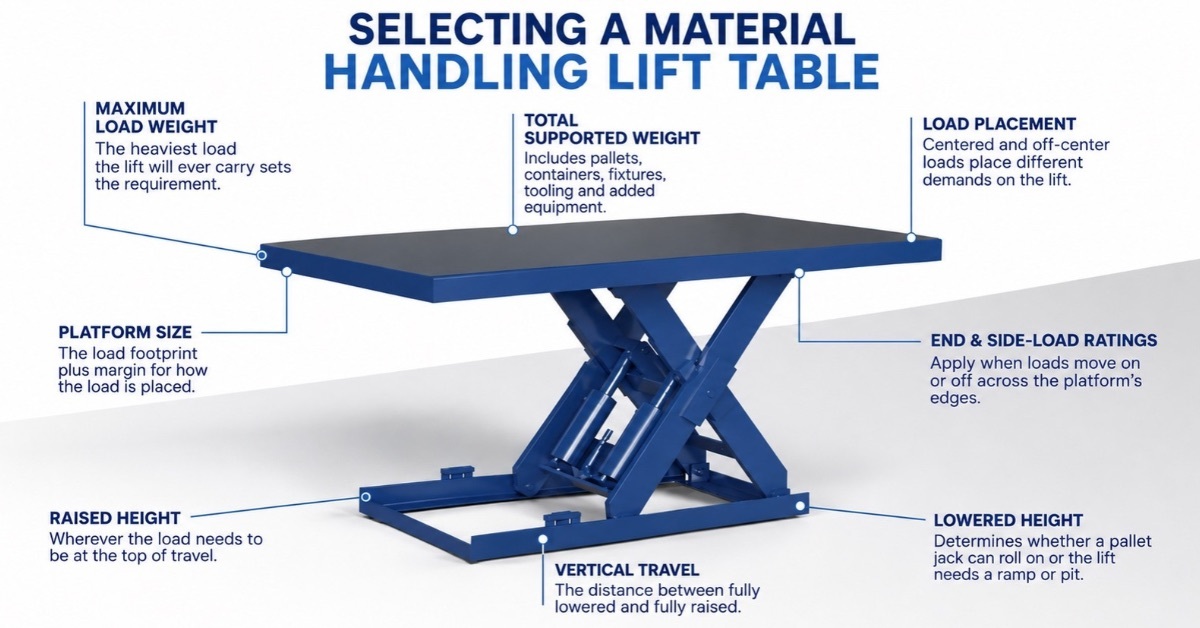


It’s natural to start a lift table search with one number: the weight of the material or product load. It matters, but it’s only the beginning. A material handling lift table also has to fit the load’s footprint, reach the right heights, work with the way materials are delivered, keep pace with production, and fit the space you actually have.
When those details are known up front, finding the right lift gets much easier. In many cases, an existing Autoquip design covers the application with little or no modification. Here’s what our team works through with customers before a lift table is selected:
- Knowing the full load, not just its weight
- Getting heights and platform dimensions right the first time
- Fitting the lift into the material flow around it
- Choosing equipment for the task it will really perform
- Planning for how hard, and where, the lift will work
- Avoiding installation surprises after the order is placed
- Saving time and cost by starting from a proven design
Already have your load and travel numbers? Share them with our team, and we’ll help narrow the options.
Lift Table Selection Starts Well Before Capacity
Capacity seems like the simplest specification to compare, but it’s also one of the easiest to underestimate. Many buyers size a lift around the weight of the product alone, without accounting for how the load is used. Total supported weight includes pallets, containers, fixtures, tooling, and any equipment added to the platform. Load placement matters too, since a centered load and an uneven or off-center load place different demands on the lift. And when loads move on or off across the platform’s edges, the lift’s separate end- and side-load ratings come into play. Autoquip distinguishes those ratings from centered lifting capacity.
Beyond capacity, the movement the load needs, how materials get to the lift and where they go next, the available space, and how often the lift cycles all determine the right equipment. When those requirements are clearly defined, many industrial applications land within one of our existing material handling lift table designs. We’ve been building lifts since 1947 and have an extensive design library to draw from.
Start With What You’re Actually Lifting
How much does it weigh? It’s a natural first question about any load, and it’s only part of the picture. Shape, balance, and everything that rides along with the product all affect which lift table will work. Here are the details our team asks about first.
What’s Being Handled
Pallets, components, containers, assemblies, tooling, raw materials. Each one behaves differently on a platform: sheet steel sits flat and stable, while a gearbox assembly may be tall and top-heavy. That gives our engineers the baseline for every decision that follows.
Maximum Load Weight
The heaviest load the lift will ever carry sets the requirement, even if it only runs once a quarter. We select lift table capacity around that true maximum.
Load Dimensions
Length, width, and height each play a role. Footprint drives the platform, and height affects stability and overhead clearance. Accurate load dimensions for the largest part you’ll handle give our team what it needs to size the platform correctly.
Weight Distribution and Center of Gravity
A load concentrated at one end, or one with a high center of gravity, stresses the structure differently than a load spread evenly across the deck. Weight distribution also affects stability as the platform rises. That’s why our team asks where the weight sits, not only how heavy the load is.
Consistent vs. Variable Loads
Some lifts handle the same pallet every cycle. Others see a different part, size, or weight each time. When loads vary, we design around the full range, including the largest footprint and the most off-center load.
Counting Everything That Rides on the Platform
Pallets, fixtures, tooling, containers, and packing materials all add weight, and they’re easy to leave out of the total. A heavy steel frame that holds a part in place while you work on it can add significant weight on its own. We include every item that sits on the platform in the load calculation.
Define Lift Height and Platform Size Before Comparing Models
Once you know what you’re lifting, the next questions are where it needs to go and how much room it needs to get there. Travel and platform size narrow the options quickly, so it pays to get them right early.
Required Vertical Travel
Vertical travel is the distance between the fully lowered and fully raised positions. It’s one of the biggest factors in how the lift is built and determines which type of lift meets your application’s needs. We base it on the actual working heights in your facility.
Raised Height
The raised height is wherever the load needs to be at the top of travel. That might be the height of a conveyor, a machine, a truck bed, or a comfortable working height for an operator. Our team measures that height from the floor so the lift reaches it every time.
Lowered Height
Lowered height is easy to overlook, and it can decide the design. It determines whether a pallet jack can roll on and whether the lift needs a ramp or a pit. We look at it early because a high lowered height can create a loading problem that extra capacity won’t solve.
Platform Length and Width
Platform size covers the load footprint plus some margin for how the load is placed. A 48 x 40 pallet on a 48 x 40 platform leaves no room for a forklift operator who sets it down an inch or two off center. We size platforms for realistic placement on a busy floor.
Load Overhang
Some loads extend past the platform by design, such as long metal bars or wide panels. Overhang shifts the center of gravity and concentrates force at the platform edge. When overhang is part of the application, our engineers design the platform and structure around it.
Available Floor Space
The lift has to fit where the work happens, along with the people and equipment around it. A platform sized perfectly for the load can still crowd an aisle that’s already busy with automated guided vehicles (AGVs), carts, and neighboring machines. That’s why we factor the whole work area into how we size the lift.
Clearances Surrounding the Equipment
Clearances matter at both ends of travel. At the top, ductwork, lighting, sprinkler lines, and overhead cranes can limit how high the load can go. At the bottom, we check for anything that could create a pinch point between the platform and nearby structures.
In the end, platform dimensions reflect both the load and how it’s handled, from the forklift that places it to the operator who works from it and the conveyor it hands off to.
Consider How Materials Get On and Off the Lift Table
Picture the load’s whole trip: it arrives at the lift, rides up or down, and moves on to the next step. A lift table is one stop on that route. How loads arrive and leave changes the lowered height, the platform design, and the accessories we recommend.
Forklifts
A forklift sets the load down from above, sometimes with less precision than a conveyor, so platform size and deck strength matter more. Forklift access also determines which sides of the lift we keep open.
Pallet Jacks
Pallet jacks roll directly onto the platform, which makes lowered height critical. A low-profile lift, or a lift set in a pit, lets a pallet jack roll on right at floor level. If the platform sits higher off the floor, you may need a ramp. Our team can help you plan for the extra floor space required.
Carts
Carts put their weight on a few small wheels, so the platform has to handle the pressure at each wheel as well as the total load. We may also add a short ramp to bridge the gap between the floor and platform, or cart stops to hold the cart in place during travel.
Conveyors
When a lift table works with a conveyor, the heights have to match precisely every cycle. The platform may carry its own conveyor section, with controls that interlock with the line so neither one moves until the other is ready. Our engineers set it up so product moves smoothly, without jams or manual intervention.
Manual Loading
When operators load or unload by hand, the lift’s job is to keep the work at a comfortable height. Platform height, edge shape, and how far operators have to reach all affect how much they bend and stretch over a shift. We design those details around the people doing the work.
Production Equipment
Some lifts receive parts from a machine or deliver parts into one, such as a press, cutting table, or robotic cell. We set the lift’s position, travel, and timing to line up with that equipment’s loading point and cycle.
A lift table works best when it’s designed to integrate into every phase of the lifting operation. Looking at what feeds the lift and the outbound handoff helps our team avoid extra handling steps and workarounds before the lift is built.
Match the Lift Table to the Job It Needs to Do
Lift tables do far more than move a load up and down. Two facilities can buy lift tables with the same capacity and use them for completely different jobs: one raises pallets to a comfortable picking height, while another feeds parts into a machine all day. The reason a facility needs a lift table shapes its travel, speed, platform design, and controls, so we look at the job before choosing the material handling lift.
Raising Materials Between Working Heights
The most basic job is moving a load from one height to another, such as floor level to a workbench or dock level to a truck bed. Here, we focus more on travel, capacity, and loading method than on fine positioning. A hydraulic lift table is well suited to this work. Its scissor lift table mechanism delivers steady, controlled motion and high capacity in a compact footprint.
Ergonomic Work Positioning
Work positioning keeps materials where operators can reach them without bending or stretching. Whether an operator is inspecting parts, packing orders, or working on a component at a bench, the lift brings the work to a comfortable height and holds it there. We design these lifts for smooth, controlled motion and easy height adjustment as tasks change.
Feeding or Unloading Production Equipment
A lift that feeds a machine presents material at a consistent height, cycle after cycle. Because the lift becomes part of the machine’s process, positioning accuracy, controls integration, and cycle speed move to the top of our list.
Pallet Handling
Picking orders from a full pallet, building a pallet layer by layer, or breaking one down are all forms of pallet handling. Platform size, lowered height for pallet jack access, and the ability to hold position as the load changes all shape the configuration we recommend.
Assembly Operations
Assembly stations often hold the work at different heights as the build progresses. Operators may work from every side of the platform. For these applications, we pay extra attention to access and guarding.
Transferring Materials Within a Production Process
Material transfer applications move product between stations or elevations inside a process, such as between two conveyor levels. Repeatability, cycle frequency, and integration with surrounding equipment drive how we design these lifts.
Factor In Frequency of Use and Operating Conditions
Will the lift run a few times a day, or steadily through every shift? Will it sit in a clean warehouse or a wet, dusty processing area? The answers affect the hydraulics, motor, structure, and finish, even when two lifts share the same capacity and travel.
Expected Cycles or Frequency of Operation
Duty cycle describes how long a lift can run relative to how long it rests. Autoquip’s existing scissor lift designs are built for 100,000 cycles per year at intermittent duty: two minutes of run time followed by eight minutes of rest. Applications beyond that need supplemental design features, so it’s important to let us know when the duty will be higher.
Production Schedule
Cycles per hour tell part of the story, and shifts per day and days per week tell the rest. A single-shift lift has recovery time built into the schedule. For lifts supporting round-the-clock operations, we plan the motor, power unit, and heat management around continuous demand.
Indoor vs. Outdoor Use
Outdoor lifts face weather, temperature swings, and sun exposure that indoor lifts never see. We choose finishes, hydraulic fluid, and electrical enclosures that withstand those conditions.
Dust, Moisture, Temperature, and Other Environmental Factors
Washdown areas, foundries, freezers, and dusty processing spaces each call for different seals, coatings, and component ratings. Some applications also benefit from stainless or galvanized construction. Our team addresses these details during selection, when it’s easiest to build them in.
Maintenance Accessibility
Routine service goes more smoothly when technicians can easily reach the power unit, cylinders, and pivot points. For lifts boxed in by a pit or other equipment, a remote power unit can help. We’ll walk you through service access during selection.
Equipment designed for occasional positioning has different requirements than equipment supporting a repetitive production process. That’s why an accurate picture of how hard the lift will work is so valuable in the first conversation with our team.
Review Installation Requirements Before Selecting the Lift
It’s easy to think of installation as something to sort out after the order is placed. But the floor, available space, and power at your site can all change which lift is the right fit. That’s why we raise these questions during selection.
Surface-Mounted vs. Pit-Mounted Installation
A surface-mounted lift table sits on the existing floor and is the simpler installation. A pit-mounted lift table sits in a recess, so the platform is flush with the floor when lowered and easy for pallet jacks, carts, and foot traffic to access. We help you weigh lowered height requirements against whether a pit is practical in your building.
Available Footprint
The installed footprint includes the lift base plus any space for a remote power unit, control station, ramp, or guarding. For a lift in a pit, the pit itself sets the footprint. Our team confirms both before a lift is selected.
Floor and Pit Requirements
The floor has to support the lift and its maximum load. For pit installations, we plan depth, dimensions, drainage, and concrete details before the lift arrives. We review floor and pit requirements early, since existing floors don’t always meet them.
Access to the Installation Location
Door openings, aisle widths, and overhead clearance along the route from the delivery truck all matter, along with the equipment available to set the lift in place. We plan that route carefully for large platforms and high-capacity units.
Electrical and Hydraulic Requirements
The type of power available at your site determines how the lift is wired, so it helps to know that early. The power unit that runs the lift’s hydraulics can sit on the lift or be mounted nearby. Our team walks you through these options, since they affect both installation and future service.
Guarding and Other Application Considerations
Guarding can include toe guards, which stop the platform if something is caught under its edge as it lowers, and bellows skirting, a flexible, accordion-style cover that encloses the scissor legs. Other options include handrails and interlocked gates, which keep the lift from moving while a gate is open. Beyond guarding, it helps to think about where operators will stand at the controls, how traffic moves past the lift, and whether it needs protection from passing vehicles. We work through these details with you while planning the installation.
Start With an Existing Autoquip Lift Table Design
By this point, you have a clear profile of your application. In many cases, that profile matches an existing lift table design, and that’s where we start every material handling lift table project.
Many Applications Fit an Established Design
Autoquip offers a broad range of lift table capacities, travels, platform sizes, and configurations. Many applications fall within those designs once the requirements are clearly defined.
A Simpler Path Through Specification
Starting from an existing industrial lift table design can simplify specification. The design has already been engineered and built by our team, so there’s less to work out from scratch. That may reduce engineering requirements and lead time, which helps when a project has a firm date or a failed lift needs replacing.
Configuration Options and Modifications
An existing design still leaves room to tailor the lift. Our engineers can adjust platform size, controls, accessories, finishes, and guarding to fit your application. You get a better fit and keep the advantages of a configuration that’s already been built and tested.
When More Extensive Engineering Makes Sense
Some applications fall outside what an existing design can reasonably handle, such as unusual load shapes, very high capacities, or close integration with complex automation. When that happens, our engineering team develops a solution around your specific requirements. Reserving that level of engineering for the applications that truly need it keeps every other project as simple as possible.
Whether the answer is a proven design, a modified one, or a more engineered solution, Autoquip covers every step, from the first load calculation to the final configuration.
Bring Your Application Details to Autoquip
The quickest route to a good fit begins with the details covered above: your load, the heights involved, how materials move, how often the lift will run, and where it will be installed. With those details, our team can recommend an existing design that meets your needs, along with any modifications that would improve how it works in your operation.
Autoquip brings more than 75 years of experience matching lift tables to industrial applications. Whether you have every detail mapped out or just a starting point, we’ll work through the rest with you.
Send us your application details and get a recommendation from our team.
Choosing the Right Lift Table With Autoquip
Choosing a lift table comes down to working through the details in order: load, capacity, dimensions, travel, workflow, frequency, and installation. Each step brings the selection into sharper focus, so you can move forward with confidence in the equipment you choose. With seven decades of application experience, Autoquip’s range of industrial lift table solutions gives you a strong starting point, and our team is ready to help match the equipment to your application.
Talk to an Autoquip representative about your material handling lift table requirements.