
Integrating VRCs and AMRs for Multi-Level Automated Storage & Retrieval


Introduction
As warehouses, distribution centers, and manufacturing facilities adopt autonomous mobile robots (AMRs) and automated storage and retrieval systems, moving material horizontally is only part of the automation challenge. Facilities with multi-level storage also need a reliable way to move pallets, loads, and mobile automation vertically while keeping each component coordinated with the larger material handling system.
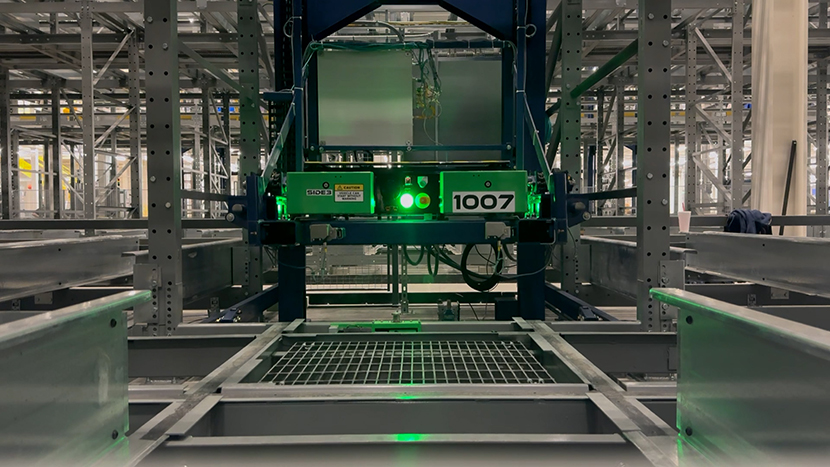
Autoquip partnered with Box Logix, AI Storage Solutions, and a leading end user to develop an integrated solution using Vertical Reciprocating Conveyors (VRCs) as the vertical transport backbone of a multi-level automated storage and retrieval system.
The project required more than simply installing material lifts between levels. The VRCs had to work as part of a coordinated automation system in which AMRs transported pallets, entered and exited the lifts, traveled between storage levels, and responded to commands from the facility’s higher-level control architecture.
The result demonstrates how VRCs, controls, AMRs, and automated storage equipment can be integrated to support complex material movement throughout a facility.
Project Challenge
The objective was to automate pallet movement through a multi-level storage racking system using AMRs for horizontal transportation and VRCs for vertical transportation.
Within the system, pallets move through a defined inbound, storage, retrieval, and return process:
- A pallet is scanned into the system and delivered to a designated transfer point.
- An AMR picks up the pallet and transports it to its assigned location within the storage racking system.
- The pallet remains in storage until it is required.
- When retrieval is requested, an AMR retrieves the pallet and transports it to a designated pick point.
- After the goods are removed, the AMR returns the pallet to its original storage location.
Because storage locations were located on multiple levels, the AMRs themselves needed to travel vertically between floors. Autoquip VRCs provided that vertical connection.
This introduced an important automation and controls challenge: an AMR riding a VRC could experience temporary signal loss during vertical travel. That could affect the AMR’s positional awareness or potentially cause it to attempt to leave the VRC before reaching the correct storage level.
The lift therefore could not operate as an independent piece of material handling equipment. Its operation had to be coordinated with the AMR fleet, storage system, and higher-level automation controls so that an AMR remained correctly positioned during vertical travel and was released only when the system confirmed that it could proceed.
Our Solution
Using VRCs as the Vertical Transport Backbone
Autoquip worked closely with Box Logix, AI Storage Solutions, and the end user to integrate the VRCs into the automated material handling process.
Rather than requiring a separate manual process to transfer loads between elevations, the VRCs allowed the AMRs to ride with their pallet loads between levels of the storage system.
This created a continuous material handling workflow in which AMRs could handle horizontal pallet movement while the VRCs handled vertical movement between storage elevations.
The key engineering challenge was controlling the transition between these two types of motion.
Shot Pin Integration for AMR Positioning
To maintain the AMR’s position while the VRC was traveling, the solution incorporated shot pins at the transition points where an AMR entered or exited a VRC.
During vertical travel, the shot pins physically secured the AMR in position on the VRC. The AMR was not released until the system received confirmation that the required conditions had been met and it was safe for the AMR to proceed.
The sequence provided a controlled process:
AMR enters VRC → AMR is secured → VRC travels to the requested level → system verifies conditions → AMR is released → AMR exits the VRC
This approach prevented the AMR from exiting prematurely and provided a controlled handoff between the autonomous mobile robot, VRC, and automated storage system.
Key Engineering and Controls Integration
Coordinating Multiple Automated Systems
A project involving AMRs, vertical lifting equipment, automated storage, and higher-level controls requires each subsystem to communicate clearly with the others.
Autoquip’s controls division, OSCO Controls, served as the integration layer between the VRC equipment and the higher-level automation software.
The lift control system interfaced directly with the larger Box Logix control architecture. OSCO developed the control logic that allowed the upstream system to command VRC movements to specific levels and coordinate load and unload events.
This required defined communication and system handshaking between the VRCs and the broader automation system so each component could confirm its status before the next operation occurred.
AMR Entry and Exit Control
OSCO’s controls logic also managed the transition of AMRs onto and off the VRCs.
The shot pins remained engaged while the VRC was moving and were controlled through logic that required the appropriate operating conditions to be verified before releasing the AMR.
This was particularly important because of the possibility of temporary AMR signal loss during vertical travel. Interlocks and fault handling were incorporated into the controls strategy to address these conditions and prevent premature movement or loss of position.
Rather than allowing the VRC, AMRs, and storage system to function as separate pieces of equipment, the controls architecture enabled them to operate as components of one coordinated automated material handling system.
How the Automated Material Handling System Works
At a system level, the application combines horizontal and vertical material movement:
- Pallet induction: A pallet enters the automated process and is scanned into the system.
- AMR pickup: An AMR collects the pallet at the designated transfer point.
- Horizontal transport: The AMR moves the pallet toward its assigned storage location.
- Vertical transfer: When another storage level is required, the AMR enters an Autoquip VRC.
- Positioning: Shot pins secure the AMR while it is on the lift.
- Vertical travel: The VRC transports the AMR and pallet to the requested level.
- System confirmation: Controls verify the appropriate conditions before the AMR is released.
- Storage: The AMR exits the VRC and transports the pallet to its assigned location.
- Retrieval: When the pallet is needed, the process is coordinated again to move it to the designated pick point.
- Return to storage: After goods are removed, the AMR returns the pallet to its storage location.
This coordinated approach allows vertical material handling to become part of the automated storage workflow rather than a separate manual transfer step.
Specifications
Application: Multi-level automated pallet storage and retrieval
Vertical transport equipment: Autoquip Vertical Reciprocating Conveyors (VRCs)
Horizontal transport: Autonomous Mobile Robots (AMRs)
Material handled: Pallets
VRC/AMR interface: Shot pin restraint at AMR transition points
Controls integration: OSCO Controls
System integration: VRC controls interfaced with the Box Logix control architecture
Storage system coordination: AI Storage Solutions
Controls functions: Lift-level commands, load and unload coordination, system handshaking, state feedback, shot pin actuation, interlocks, and fault handling
AQ Project#
167534
The Results
The completed project demonstrates how VRCs can be integrated into advanced warehouse automation and automated storage and retrieval applications where materials and autonomous mobile equipment need to move between multiple elevations.
Rather than functioning as standalone lifts, the Autoquip VRCs became an integrated part of the overall material handling process. Controls coordination enabled the larger automation system to command lift movements, coordinate AMR entry and exit, and receive feedback from the VRC system.
The project demonstrates Autoquip’s ability to:
- Integrate VRCs into automated storage and retrieval applications.
- Coordinate vertical material movement with AMRs and higher-level automation systems.
- Interface lift controls with larger system-integrator control architectures.
- Develop controls logic for coordinated load and unload events.
- Address AMR positioning during vertical travel using shot pins, interlocks, and fault-handling logic.
- Work collaboratively with system integrators, storage-system providers, and end users on complex material handling automation projects.
Most importantly, the project illustrates an approach to a growing material handling challenge: connecting horizontal autonomous material movement with vertical transportation in multi-level facilities.
Integrating Vertical Lifting into Warehouse and Material Handling Automation
As automation expands throughout warehouses, distribution centers, and manufacturing operations, material often needs to move across more than one axis. Conveyors, AMRs, and other automated equipment can transport products horizontally, while VRCs provide a way to extend automated material flow vertically between elevations.
Autoquip designs VRC and custom lifting solutions that can be engineered to work within larger material handling and automation systems. Through Autoquip’s mechanical lifting expertise and OSCO Controls’ controls and systems integration capabilities, lift equipment can be coordinated with PLCs, sensors, conveyors, AMRs, storage systems, and higher-level automation architectures.
For applications involving multi-level storage, automated pallet handling, vertical material movement, or integration of lifting equipment into an automated process, Autoquip can work with end users and system integrators to develop a solution around the requirements of the complete material handling system.
