
How Vertical Movement Impacts Automated Material Flow
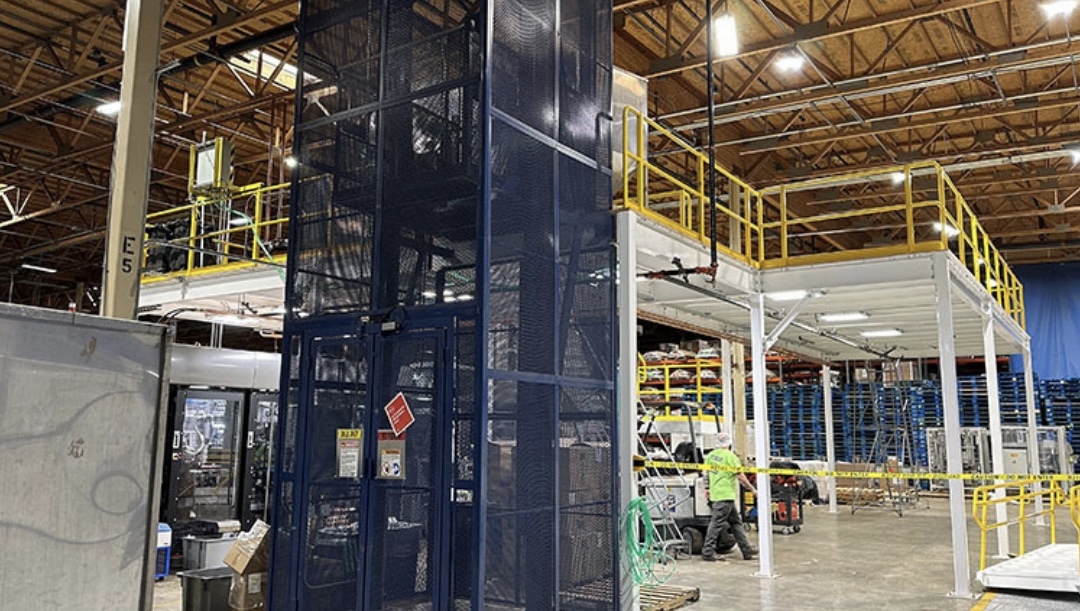


Vertical Material Flow Automation — How Lift Systems Keep Multi-Level Operations Moving
Automated material handling systems are only as efficient as their least capable link. When horizontal flow is fast and fully integrated but vertical movement between levels is slow, manual, or disconnected from the broader system, the result is a bottleneck that limits throughput across the entire operation. In multi-level manufacturing and intralogistics environments, vertical movement isn’t an afterthought — it’s a critical component of how material flows from process to process and floor to floor.
Vertical material flow automation bridges the gap between levels, processes, and systems — allowing facilities to maintain the same speed, consistency, and integration that their horizontal automation delivers. When lift systems are designed to interface with conveyors, AGVs, AS/RS systems, and automated workflows, vertical movement becomes a seamless part of the operation rather than a point of friction.
This article explores how vertical movement affects automated material flow — and how VRCs, lift systems, and integrated automation solutions help improve throughput, reduce bottlenecks, and support efficient movement across multi-level operations:
- Why vertical movement is often a bottleneck in automated operations
- Where vertical movement challenges most commonly occur
- The types of lift systems that support vertical material flow automation
- The operational benefits of optimizing vertical movement in automated environments
- How Autoquip engineers lift and automation solutions for multi-level material handling
Vertical movement shouldn’t be the bottleneck in your automated operation. Contact Autoquip today to discuss your application.
When Vertical Movement Becomes the Key Bottleneck
Automated systems in manufacturing and intralogistics depend on continuous, predictable material flow. When that flow is interrupted — by a manual transfer between levels, a lift that can’t keep pace with system throughput, or a gap between a vertical movement solution and the automation platform it’s supposed to support — the disruption ripples outward. Production slows. Buffers fill up. Downstream processes wait.
Vertical movement is one of the most common sources of these disruptions in multi-level operations. Facilities invest heavily in horizontal automation — conveyor systems, AGVs, ASRS systems, automated picking solutions — but the transitions between levels often don’t receive the same attention. The result is a mismatch between what the automated system can deliver horizontally and what the facility can actually move vertically. Inefficient transfers between floors and systems reduce throughput and undermine the performance of the broader automation investment. Integrated lift systems are how that gap gets closed.
Where Vertical Movement Challenges Occur
Vertical movement challenges aren’t limited to a single type of facility or operation. They show up wherever materials need to move between levels — and wherever that movement isn’t fully integrated into the surrounding automation environment.
Multi-Level Manufacturing Operations
In manufacturing environments with production processes spread across multiple floors, vertical movement between process steps is a recurring challenge. When materials have to be manually transferred between levels — or when lift systems operate independently from the production control environment — the result is inconsistent cycle times, manual labor that automation was supposed to replace, and throughput that’s limited by the weakest link in the vertical transfer chain.
Mezzanines and Elevated Storage Areas
Mezzanines and elevated storage areas are common in warehousing and manufacturing facilities looking to maximize vertical space. But the efficiency gains of elevated storage are only realized if materials can move between levels quickly and reliably. When vertical movement to and from mezzanine levels is slow or manually intensive, the storage capacity advantage is offset by the handling inefficiency it creates.
Warehouse Picking and Transfer Zones
In warehouse and distribution environments, picking and transfer zones that span multiple levels create frequent vertical movement requirements. Automated warehouse movement between picking zones, conveyor systems, and staging areas depends on lift solutions that can interface with the surrounding automation — receiving loads from conveyors, transferring to AGVs, and maintaining the pace required by high-volume order fulfillment.
Automated Conveyor and AS/RS Systems
Automated conveyor systems and AS/RS systems operate at defined speeds and cycle times. When vertical transitions between conveyor levels or between AS/RS storage positions and downstream processes can’t match those speeds, the entire system is forced to slow to the pace of its slowest component. ASRS systems that can’t transfer materials to downstream processes without manual intervention or slow vertical lifts represent exactly the kind of integration gap that reduces automation ROI.
Lift Systems That Support Vertical Material Flow
Not all lift systems are designed for integration into automated material handling environments. The solutions that support vertical material flow automation share a common characteristic — they’re engineered to interface with the surrounding system, not just to move materials up and down independently.
Vertical Reciprocating Conveyors (VRCs)
Vertical reciprocating conveyors are purpose-built for moving materials safely and efficiently between levels in industrial environments. Unlike passenger elevators or forklifts, VRCs are designed specifically for automated vertical material handling — meeting or exceeding ASME B20.1 safety standards and delivering the cycle frequency, load capacity, and reliability that automated operations demand. Our mechanical VRCs support high-volume, multi-level applications with vertical travel up to 100 feet and capacities up to 20,000 lbs. Hydraulic models offer a cost-effective solution for two-level applications with loads up to 6,000 lbs. Both VRC types can be customized to meet the specific requirements of your application — from platform size and load capacity to control interfaces and integration features.
Where VRCs are particularly valuable in automated environments is in their ability to interface with conveyor systems and automation platforms. Our VRCs can be equipped with automated controls, conveyor integration features, and precision positioning capabilities that enable them to function as seamless nodes in an automated material flow system — receiving loads automatically, transferring to downstream conveyors, and communicating with facility control systems without manual intervention. That connectivity extends beyond the lift itself. Real-time diagnostics, IoT connectivity, and seamless integration with facility automation systems are standard on every Autoquip VRC — delivered through AQ Connect, our proprietary cloud-based remote monitoring and control platform.
Lift Systems for AGVs and AS/RS
AGV-integrated lift systems and AS/RS-compatible lift solutions require a level of precision, repeatability, and control system integration that standard lift equipment typically can’t provide. When an AGV needs to transfer a load to a different level, the lift has to be in the right position, at the right time, with the right interface — every cycle. The same precision applies to AS/RS integration, where vertical material handling systems must operate in tight coordination with automated storage and retrieval sequences.
Our engineering team designs lift systems specifically for AGV integration and AS/RS interfacing — accounting for positioning tolerances, load transfer sequences, control system communication protocols, and the cycle frequency demands of high-throughput automated environments. We’ve engineered complex integrations that enable VRCs, AGVs, and AS/RS systems to operate as a single unified workflow — with real-time communication between the lift control system and the AGV management platform, ensuring that every load arrives at the right position, at the right time, every cycle. The result is vertical movement that supports automated transfer between systems rather than interrupting it.
Conveyor-Integrated Lift Systems
In facilities where conveyor systems span multiple levels or where elevation changes are part of the production or distribution flow, conveyor integration systems bridge the gap between conveyor runs at different heights. These solutions are designed to accept loads directly from an in-feed conveyor, transport them vertically, and deliver them to an out-feed conveyor at the destination level — all without manual handling and with minimal disruption to conveyor system throughput.
Conveyor-integrated lift systems are a key component in continuous material handling environments where stopping the flow — even briefly — has downstream consequences. Our conveyor-integrated solutions are engineered for the specific throughput, load, and interface requirements of each application, ensuring that vertical movement supports rather than limits the performance of the broader conveyor system.
Benefits of Optimized Vertical Material Flow
When vertical movement is properly integrated into an automated material handling system, the operational benefits are felt across the entire operation — not just at the lift itself.
Improved Throughput and Automation Efficiency
Lift systems that match the speed and integration requirements of the surrounding automation allow the entire system to operate at its designed throughput. When vertical movement keeps pace with horizontal flow, automation efficiency improves across the board — fewer bottlenecks, more consistent cycle times, and better utilization of the automated equipment on both sides of the vertical transition.
Reduced Bottlenecks Between Levels and Zones
Properly specified and integrated vertical material handling systems eliminate the most common source of flow interruption in multi-level operations. Materials move between levels on schedule, buffers don’t overflow, and downstream processes receive materials when they’re expected. The result is a smoother, more predictable operation that delivers the throughput the automation investment was designed to support.
Better Use of Facility Space
Efficient vertical material flow enables facilities to make full use of available vertical space — mezzanines, elevated storage, multi-level production layouts — without sacrificing operational efficiency. When vertical movement isn’t a constraint, facility designers have more flexibility to optimize space utilization and reduce the footprint required to support a given production or distribution volume. In some cases, that flexibility can defer or eliminate the need for facility expansion or relocation entirely — a significant capital consideration for growing operations.
More Reliable Automated Operations
Lift systems that are designed for automation integration are also designed for the reliability that automated operations demand. Consistent performance, predictable cycle times, and robust control system interfaces reduce the variability that undermines automation reliability. When the vertical movement component of a material flow system is as reliable as its horizontal components, the entire system benefits.
Reduced Manual Material Handling
One of the primary goals of intralogistics automation is to reduce the manual labor involved in material movement. Vertical movement that requires manual intervention — a forklift transfer between levels, a manual load/unload at a lift — reintroduces the labor, inconsistency, and safety risk that automation is designed to eliminate. Integrated lift systems that handle vertical movement automatically keep material flow continuous and reduce manual handling, thereby improving automation efficiency.
Why Vertical Movement Deserves the Same Engineering Attention as the Rest of Your Automation
Vertical movement plays a major role in automated material flow — and when it’s disconnected from the systems around it, it becomes the constraint that limits what the rest of the operation can deliver. Multi-level material flow depends on vertical movement that matches the speed and integration of the systems around it. Integrated lift systems improve efficiency across multi-level operations. VRCs and automation-ready lift systems — including VRC automation integration with conveyors, AGVs, and AS/RS platforms — support scalable material handling strategies. And optimized vertical movement reduces delays and improves throughput in ways that compound across the entire automated workflow.
Autoquip brings more than 75 years of engineering experience to every vertical material flow project. That depth of expertise — and, when the application calls for it, the ability to partner with OSCO Controls, our division of highly skilled controls engineers — means we can deliver innovative and fully integrated automation solutions that extend well beyond the lift itself.
Autoquip — Engineering Vertical Material Flow Solutions for the Future of Industrial Automation
Vertical movement shouldn’t be the weak link in your automation investment. When lift systems are properly engineered and integrated, they become an invisible part of the operation — moving materials between levels reliably, automatically, and at the pace your automation demands. That’s what we build at Autoquip.
From vertical reciprocating conveyors to fully integrated lift systems, Autoquip supports facilities in improving vertical material flow and automation efficiency. Contact us today to discuss your application.