
The Advantages of Hydraulic Work Platforms for Material Handling and Access
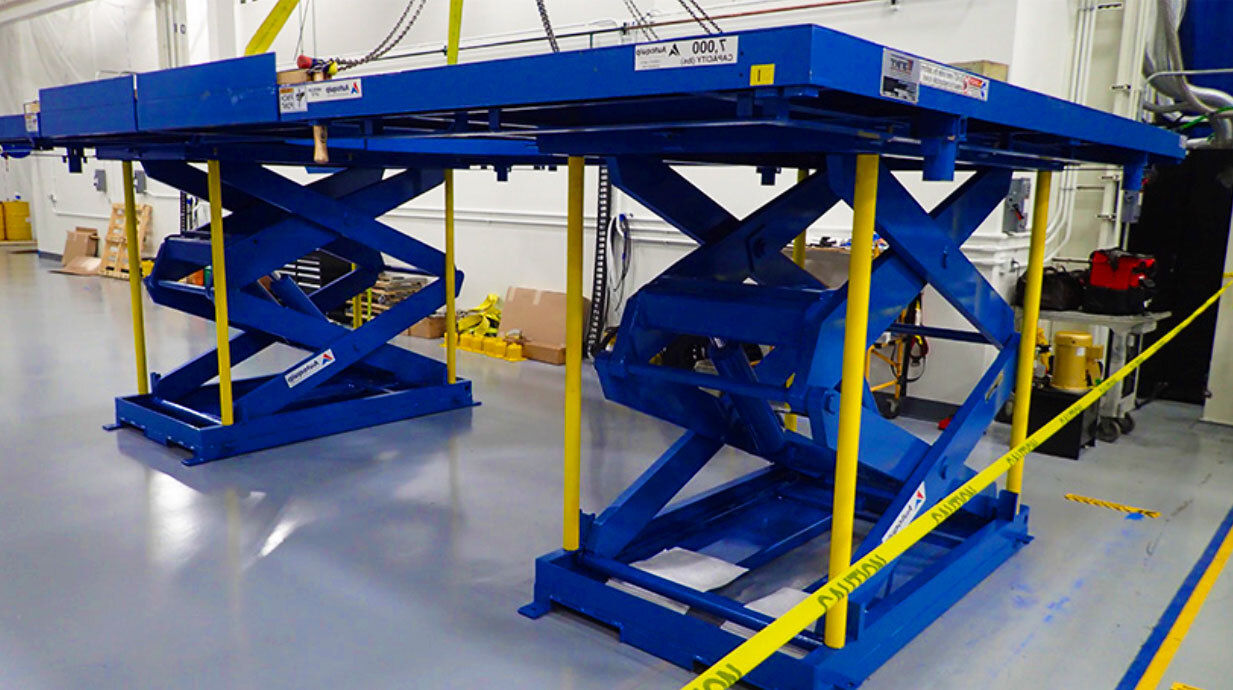


Why Hydraulic Work Platforms Are a Proven Solution for Industrial Access and Material Handling
Demand for safe, reliable elevated work access continues to grow across industrial environments. From maintenance and inspection to assembly and production workflows, manufacturers need lift platforms that provide stable positioning, controlled movement, and confidence at height. Hydraulic work platform lifts have long been a preferred solution for these requirements, offering smooth lifting, consistent load handling, and flexible design options suited to a wide range of applications.
At Autoquip, we engineer hydraulic work platforms to perform reliably in demanding industrial environments. These platforms are designed to support both worker access and material handling, providing predictable movement, stability under load, and customization flexibility that aligns with real-world operating conditions.
In this article, we’ll explain:
- What hydraulic work platforms are and how they operate
- The key advantages that make hydraulics the go-to choice for many applications
- When hydraulic platforms are the best solution—and when mechanical systems may be recommended
- How hydraulic and mechanical work platforms compare for industrial access and positioning
- How safety is engineered into hydraulic work platforms
- What to consider when selecting a hydraulic work platform for your facility
Why Hydraulic Work Platforms Matter
Industrial operations increasingly rely on elevated work access for maintenance, assembly, inspection, and production tasks. As equipment grows larger and processes become more complex, safe and stable access at height is no longer optional—it is a foundational requirement for productivity, ergonomics, and worker safety.
Hydraulic work platforms play a critical role in meeting this need. Their ability to lift heavy loads smoothly, maintain stability during travel, and adapt to a wide range of configurations makes them well-suited for many material handling and access applications. These characteristics have made hydraulic systems a mainstay across manufacturing, aerospace, transit, and heavy equipment environments.
Beyond basic elevation, hydraulic work platforms support consistent access positioning, which is critical for repetitive tasks and ergonomic alignment. When operators can rely on predictable platform behavior and stable positioning, they spend less time compensating for movement and more time focused on the task at hand. This consistency supports productivity while also reducing physical strain and fatigue during extended work at height.
While mechanical lifting systems are selected in applications where speed or extremely high duty cycles are required, most of the work platform lifts we design are hydraulic. Their smooth, consistent movement, stability, and load-handling capability make them the preferred solution for the majority of access and positioning applications.
What Are Hydraulic Work Platforms?
Hydraulic work platforms are lifting systems that raise and lower a platform using hydraulic cylinders powered by pressurized fluid. Movement is controlled through valves, flow controls, and integrated safety components that regulate speed, direction, and stopping behavior.
These platforms are used for both worker positioning and material handling, allowing operators to safely access elevated areas or bring work to an ergonomic height. Depending on configuration, hydraulic work platforms may be surface-mounted, pit-mounted, mobile, or integrated directly into production equipment.
Hydraulic work platforms are commonly used in aerospace assembly and maintenance, manufacturing and fabrication operations, transit and vehicle maintenance facilities, and heavy equipment service environments—anywhere stable, controlled access at height is required.
Key Advantages of Hydraulic Work Platforms
Hydraulic work platforms offer several advantages that align closely with industrial access and positioning requirements. At Autoquip, these benefits are reinforced through engineering practices that focus on safety, durability, and application-specific performance.
Smooth, Controlled Lifting Motion
Hydraulic pressure enables smooth, steady elevating with minimal vibration or abrupt movement. Unlike systems that rely on mechanical engagement for motion, hydraulic platforms provide controlled acceleration and deceleration throughout the lifting cycle.
This smooth, consistent movement is essential for safety-sensitive tasks such as assembly, inspection, and maintenance, where sudden motion can increase risk or reduce precision. Controlled lifting also helps reduce operator fatigue and improves confidence when working at height.
Hydraulic systems inherently absorb and regulate force through fluid pressure, which helps dampen vibration and minimize abrupt motion. This characteristic allows platforms to start, travel, and stop smoothly even under varying load conditions. For applications involving tooling, fixtures, or precision work, this controlled motion helps maintain alignment and reduces the risk of rework or accidental damage.
Strong, Consistent Lifting Force
Hydraulic systems deliver consistent lifting force throughout the entire range of travel, making them effective for heavy, oversized, or uneven loads. Because the lifting force is generated by hydraulic pressure, performance remains steady regardless of platform height or load position.
This capability makes hydraulic work platforms ideal for high-capacity lift platforms and large custom configurations where weight distribution may vary. Autoquip engineers hydraulic platform lift systems to maintain performance and stability even as load conditions change during operation.
Stability at Height
Stability is a defining advantage of hydraulic work platforms. Hydraulic cylinders provide continuous support throughout the lift cycle, helping the platform remain steady at full elevation.
This stability reduces worker fatigue, improves task accuracy, and enhances overall safety. For applications requiring extended time at elevation—such as detailed assembly or inspection work—platform stability is a critical factor in productivity and operator confidence.
Flexible Design Options for Customization
Hydraulic work platforms can be engineered to accommodate a wide range of footprints, travel heights, and load requirements. This flexibility supports custom designs that align with specific facility layouts and operational workflows.
Autoquip regularly designs hydraulic platforms with multi-scissor configurations, dual platforms, carousel arrangements, and specialized tooling interfaces. These configurations enable platforms to support complex tasks, bidirectional access, and integrated workflows without compromising safety or performance.
This design flexibility allows Autoquip to engineer platforms that integrate directly into production workflows rather than forcing facilities to adapt their processes around standard equipment. From custom platform shapes and extended travel heights to integrated tooling mounts and carousel-style arrangements, hydraulic platforms can be tailored to support specific tasks while maintaining stability and safety throughout the operating range.
One example of this flexibility is demonstrated in Autoquip’s carousel work platform designs, where hydraulic platforms were designed to rotate and position operators precisely around complex tooling fixtures. In this application, smooth hydraulic motion and stable positioning were essential to support repeatable work at height while accommodating specialized equipment and unique access requirements.
Proven Reliability in Industrial Environments
Hydraulic lifting systems typically have fewer moving mechanical components than alternative drive systems. This simplicity contributes to long-term reliability, particularly in harsh or demanding industrial environments.
With proper design and maintenance, hydraulic work platforms provide dependable operation over extended service lives. In many applications, this translates to lower long-term maintenance demands and predictable performance in daily operation.
When Hydraulic Platforms Are the Best Choice
Hydraulic work platforms are especially well-suited for applications where control, stability, and load capacity are primary considerations.
Hydraulic platforms are often the best choice:
- When precise, smooth movement is required for safety-sensitive tasks
- For heavy-duty or oversized loads that demand consistent lifting force
- When stability at full elevation is critical
- For large custom work platforms such as maintenance stands, assembly lifts, and pit-mounted systems
In aerospace manufacturing environments, hydraulic work platforms are often selected to support ergonomic access to large assemblies where precision, stability, and operator confidence are critical. Autoquip has engineered advanced ergonomic work platform systems for aerospace applications that rely on hydraulic lifting to provide controlled motion, consistent positioning, and adaptable access across multiple work zones.
In applications where speed or rapid cycling is the primary requirement—such as certain high-throughput manufacturing environments—mechanical lifting systems may be recommended instead.
Comparing Hydraulic vs. Mechanical Work Platforms
Both hydraulic and mechanical work platforms serve important roles in industrial environments. Understanding their differences helps ensure the right solution is selected for each application.
Hydraulic work platforms are valued for:
- Smooth, consistent motion
- Superior load-handling capability
- Stability at height
- Flexibility for custom designs
Mechanical work platforms are typically selected for:
- Faster vertical travel
- High-cycle or continuous-duty applications
- Environments where speed is prioritized over load variability
For most access and positioning applications, hydraulic systems remain the preferred solution due to their smooth, consistent movement, load-handling capability, and stability. Mechanical systems are selected when higher travel speeds or rapid cycling are the primary requirements.
Safety Features of Hydraulic Work Platforms
Safety is engineered into hydraulic work platforms through both system design and integrated components. Autoquip platforms incorporate features intended to protect operators, maintain controlled motion, and support reliable operation during elevated work.
- Flow controls for smooth stop/start:
Hydraulic flow controls regulate lifting and lowering speed, supporting smooth acceleration and deceleration throughout the platform’s travel. - Velocity fuses to prevent sudden descent:
Velocity fuses may be incorporated to stop uncontrolled movement in the event of a hydraulic line failure, helping maintain platform stability under abnormal conditions. - Guardrails, toe boards, and operator controls:
Integrated guardrails and toe boards provide physical fall protection, while clearly positioned operator controls support intuitive and safe platform operation. - Redundant hydraulic components:
Many platform designs incorporate redundant hydraulic elements to enhance reliability and reduce the impact of component failure. - Compliance with applicable ANSI/ASME standards:
Depending on configuration and application, hydraulic work platforms may be designed to comply with relevant ANSI and ASME standards, supporting consistent safety and performance expectations.
What to Consider When Choosing a Hydraulic Work Platform
Selecting the right hydraulic work platform requires evaluating both operational needs and environmental conditions to ensure safe, reliable performance over the life of the equipment. The following checklist helps guide that evaluation and ensures key requirements are considered early in the selection process.
Checklist considerations include:
- Required lifting capacity
Determine the maximum load the platform must safely raise, including
workers, tools, and materials. - Platform size and usable working area
Verify the surface area needed to support tasks comfortably and safely at
elevation. - Vertical travel height
Measure the total lift required to reach work areas or equipment access points. - Duty cycle and frequency of use
Establish how often the platform will be raised and lowered during regular
operation. - Integration with adjacent equipment, tooling, or automation systems
Assess whether the platform must align with production equipment, fixtures,
or automated workflows. - Environmental conditions
Evaluate indoor or outdoor use, temperature extremes, debris exposure, or
other site-specific factors that may affect performance.
Evaluating these factors early helps ensure the selected platform supports both current requirements and future operational changes.
Evaluating Hydraulic Work Platforms for Your Application
Hydraulic work platforms deliver smooth, consistent movement, stability at height, and the design flexibility required for real industrial access and positioning challenges. When you’re evaluating options for capacity, travel, duty cycle, and integration, application-specific engineering makes the difference between a platform that simply lifts—and one that supports safe, repeatable work.
Why Hydraulic Work Platforms Remain an Industry Standard
Hydraulic work platforms continue to be a foundational solution for industrial access and material handling applications. Their smooth, consistent movement, stability at height, high load capacity, and customization flexibility make them well-suited for a wide range of environments.
When engineered for the application, hydraulic platforms provide a safe, reliable, and cost-effective way to elevate workers and materials. While mechanical systems have a place in speed-driven, high-cycle applications, hydraulic work platforms remain the preferred choice for most access and positioning needs.