
Custom VRC Solutions for Streamlined Automated Workflows


How Custom VRC Solutions Eliminate Vertical Material Handling Bottlenecks
Does your automated workflow stall when materials need to move between floors? Most facilities invest heavily in horizontal material handling—conveyors, AGVs, sophisticated ASRS systems—only to discover that vertical movement becomes the limiting factor in their operation. Forklifts interrupt automated processes, manual handling creates safety risks and delays, and standard freight elevators can’t communicate with modern automation systems. The solution isn’t working around vertical movement challenges—it’s integrating custom VRC solutions that function as seamless extensions of your automated workflows. In this article, we’ll cover:
- Why automated vertical material handling creates bottlenecks in otherwise streamlined facilities
- How custom VRC engineering addresses capacity, safety, and integration challenges
- Proven efficiency and safety improvements from industrial vertical lifts
- Real-world examples of custom VRC systems integrated with AGV and ASRS equipment
- Key factors for selecting a VRC manufacturer that understands automation integration
- Strategies to maximize ROI from your existing AGV investment through lift integration
- Autoquip’s proven approach to designing custom AGV lift solutions for assembly-intensive industries
Looking to eliminate vertical handling bottlenecks in your facility? Contact Autoquip to discuss custom VRC solutions engineered for your automation systems.
Why Vertical Movement Remains the Weak Link in Automated Facilities
The past decade has brought remarkable advances in horizontal material handling automation. AGVs navigate complex routes autonomously, conveyor systems route products with precision, and ASRS equipment manages inventory with minimal human intervention. Yet when materials need to move between floors or storage levels, many facilities revert to manual processes or equipment that can’t integrate with their automation infrastructure. The global vertical reciprocating conveyor (VRC) market reached $645 million in 2024 and is projected to grow to $1.1 billion by 2034, driven by increasing demand for automated vertical material handling solutions that eliminate these workflow gaps.
Forklifts require operators and create safety zones that interrupt automated workflows. Freight elevators lack the control interfaces and communication protocols that modern automation systems require. Manual cart handling adds time, labor costs, and injury risk to operations that are otherwise highly automated. These vertical handling gaps limit throughput, create scheduling conflicts, and represent a persistent weak point in otherwise sophisticated material handling systems. Custom vertical reciprocating conveyors (VRCs) solve this integration challenge by functioning as intelligent nodes within automated workflows rather than isolated lifting equipment. Industrial vertical lifts designed for automation environments deliver the performance, reliability, and integration capabilities that modern facilities require.
What Transforms a Standard Lift Into a Custom VRC Solution?
Not all vertical reciprocating conveyors are created equal. Standard VRCs serve basic lifting functions, but custom VRC solutions are engineered to integrate seamlessly into specific operational environments and automation systems. Industrial vertical lifts built for automated workflows require capabilities that go far beyond simple up-and-down movement.
Platform Engineering for Diverse Load Requirements
Custom VRC platforms are sized and configured for your specific materials and containers. Platform dimensions accommodate your pallet sizes, tote dimensions, or cart configurations without wasted space or capacity limitations. Load capacities are engineered to handle your actual weights—from lightweight totes to multi-ton industrial loads—with appropriate safety margins. Travel heights are calculated to serve your exact floor-to-floor or mezzanine requirements, optimizing cycle times. Whether you need automated vertical material handling for light assembly components or heavy manufacturing materials, platform engineering ensures the custom VRC matches your operational demands.
Safety Systems Tailored to Operational Context
Safety features in custom VRCs go beyond standard compliance to address your facility’s specific risk factors. Interlock systems prevent access during operation while accommodating your workflow patterns. Gate configurations match your loading procedures and space constraints. Overload protection systems are calibrated to your actual load profiles, preventing equipment damage without false positives that interrupt operations. Emergency stop systems integrate with facility-wide safety protocols and notification systems.
Control Integration That Enables Automation
The defining characteristic of custom VRC solutions is control system engineering that enables true automation integration. Custom VRCs communicate with AGV management systems, coordinating lift cycles with vehicle arrivals and departures. They interface with ASRS controllers, synchronizing vertical and horizontal storage retrieval operations. PLC integration allows industrial vertical lifts to function as nodes within larger automation networks, receiving commands and reporting status in real time. Every Autoquip vertical reciprocating conveyor (VRC) also includes AQ Connect, our proprietary cloud-based remote monitoring and control system that provides IoT connectivity, diagnostics and communications, and seamless integration capabilities with facility automation systems. These control capabilities transform VRCs from manually operated lifts into intelligent components of automated vertical material handling systems.
How Custom VRCs Enhance Automated Workflow Performance
The benefits of custom VRC integration extend beyond simply moving materials vertically. Properly engineered solutions create measurable improvements across multiple operational dimensions.
Throughput Improvements Through Seamless Integration
When custom VRC systems integrate directly with automation, vertical movement stops being a bottleneck. AGVs can deliver loads to VRCs, trigger lift cycles automatically, and retrieve materials at destination levels without human intervention. Production lines maintain a steady flow even when materials must move between floors. Storage and retrieval operations execute without waiting for operators or manual equipment. The result is throughput that matches your horizontal handling capacity rather than being constrained by vertical movement limitations.
Space Utilization That Supports Operational Density
Custom VRC installations enable effective use of vertical space that would otherwise remain underutilized. With warehouse costs reaching $8.31 per square foot in 2024 and optimal utilization rates targeting 22-27%, maximizing vertical space has become essential for operational efficiency. Mezzanines become accessible storage or production areas without requiring ramps or extensive floor space for access equipment. Multi-level facilities can operate at higher density because automated vertical material handling doesn’t consume valuable floor area for ramps or lift equipment staging. Compact custom VRC installations fit into existing layouts, often occupying less space than the forklift traffic patterns they replace.
Safety Advantages Over Alternative Methods
Automated vertical material handling with custom VRC systems reduces injury risk compared to forklifts or manual methods. Automated operation eliminates the ergonomic strain of manual lifting and carrying materials between levels. Enclosed lift wells prevent fall hazards and unauthorized access during operation. Industrial vertical lifts don’t create the pedestrian-vehicle interaction risks that forklifts introduce into automated environments. Consistent, controlled lifting eliminates the dropped load risks associated with manual handling or forklift operations.
Operational Flexibility for Evolving Systems
Custom VRC solutions adapt as automation systems evolve. Control interfaces can be reprogrammed to accommodate new AGV management software or ASRS upgrades. Platform configurations can be modified if container types or load profiles change. Communication protocols can be updated to integrate with additional automation equipment. This flexibility protects your investment even as surrounding systems are upgraded or replaced.
Case Study Spotlight: AGV Rack System Integration
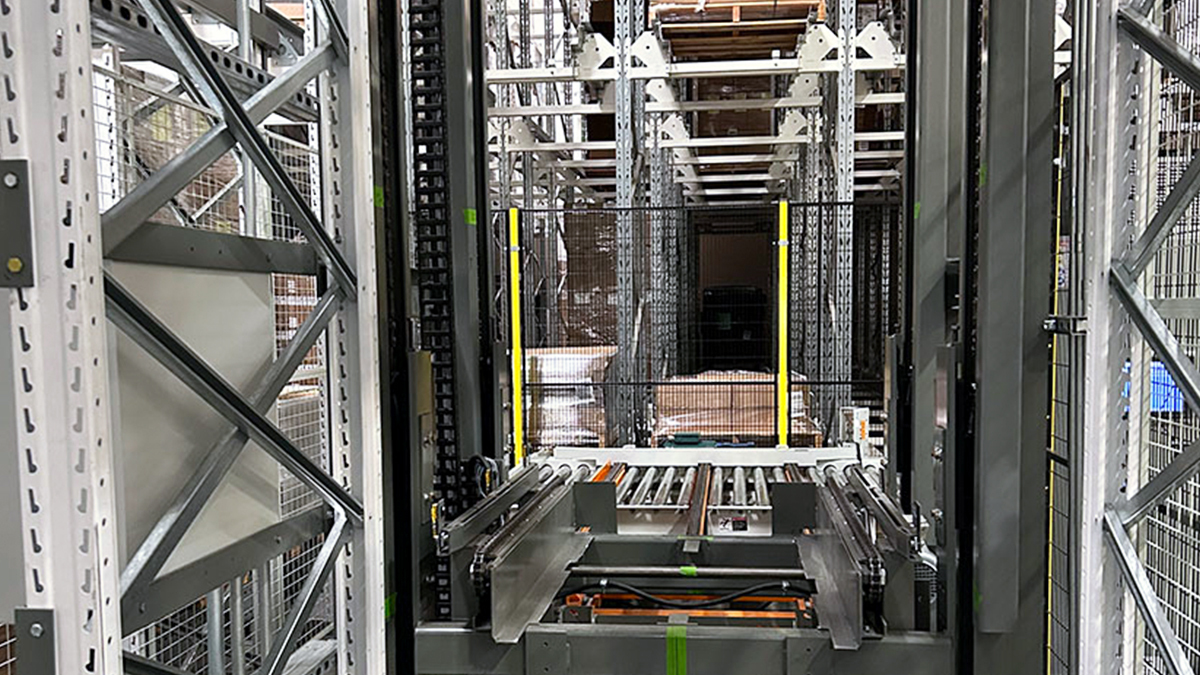
Our Automated VRC for AGV Rack System Retrieval and Storage project demonstrates the integration possibilities when vertical reciprocating conveyors (VRCs) are custom-engineered for automation. This installation required seamless communication between the custom VRC control system and the facility’s AGV management software. Working with OSCO Controls, part of the Autoquip family of companies, we developed sophisticated control solutions that coordinate lift cycles with AGV arrivals, enabling fully automated material flow between storage levels.
The result is an automated vertical material handling system that functions as an integrated component of the storage and retrieval operation rather than a separate process requiring manual oversight. This project showcases how custom VRC engineering and advanced control integration eliminate vertical handling bottlenecks in sophisticated automation environments.
Selecting a VRC Partner for Automation Integration Success
The difference between adequate and exceptional VRC performance often comes down to the manufacturer’s experience with automation integration. Several factors separate VRC suppliers who provide equipment from engineering partners who deliver integrated solutions.
Custom Engineering Capabilities
Look for manufacturers with in-house engineering teams capable of designing solutions from requirements rather than configuring standard products. This includes mechanical engineering for platform and structure design, electrical engineering for control system integration, and software engineering for communication protocol implementation. The ability to engineer custom solutions determines whether your vertical reciprocating conveyor (VRC) will truly integrate with your automation systems or simply coexist alongside them.
Automation Integration Experience
Evaluate the manufacturer’s track record with automation integration projects similar to yours. Have they successfully integrated custom VRC systems with your specific AGV management software? Do they have experience with your ASRS equipment manufacturer? Can they provide references from facilities with comparable automation complexity? Experience with your automation ecosystem significantly reduces integration risk and implementation time for industrial vertical lifts.
Cross-Industry Expertise
Manufacturers serving diverse industries demonstrate adaptability and engineering capability. Experience with automotive, warehousing, manufacturing, and distribution operations means the engineering team has solved varied integration challenges and can apply lessons learned across applications. This cross-industry perspective often leads to innovative custom VRC solutions that wouldn’t emerge from narrow specialization.
American Manufacturing Quality
Domestic manufacturing provides advantages for custom VRC projects. American-made industrial vertical lifts support faster iteration during the engineering phase, enable better communication throughout the project, and facilitate easier long-term support. As we explored in our recent blog on American-Made Lift Systems for Factory Modernization, domestic engineering and manufacturing resources create meaningful benefits for custom automation integration projects involving vertical reciprocating conveyors (VRCs).
Transform Vertical Material Handling Into a Competitive Advantage
Vertical movement doesn’t have to be the limiting factor in your automated workflows. Custom VRC solutions engineered for seamless integration eliminate bottlenecks, improve safety, and enable the operational density that modern facilities require. The key is working with a manufacturing partner who approaches industrial vertical lifts as integrated automation components rather than standalone lifting equipment.
Autoquip has engineered custom vertical reciprocating conveyors for automated facilities across industries for decades. We understand how custom VRC systems must integrate with AGV equipment, ASRS networks, and facility automation infrastructure. Our engineering team designs solutions that match your exact requirements—load capacities, platform configurations, travel heights, and control system interfaces—to ensure automated vertical material handling enhances rather than limits your automation performance.
Ready to eliminate vertical handling constraints in your automated facility? Reach out to our team of experts to discuss how custom VRC engineering can streamline your material handling workflows.
Engineer Vertical Material Handling Solutions with Autoquip
Every project teaches us more about the control system requirements, safety considerations, and engineering details that separate adequate vertical handling from truly optimized automated material flow. That accumulated knowledge informs how we approach each new custom VRC project, ensuring solutions that deliver reliable performance throughout their service life.
Ready to explore how custom VRC engineering can transform your facility’s vertical material handling? Discover more about Autoquip’s VRC Solutions and our latest insights on automation applications that are reshaping modern material handling.
- VRC Solutions
- Warehouse ASRS Integration with Custom Lift Systems
- Integrating AS/RS and VRC Systems for Seamless Material Handling
- Emerging Technologies and Future Trends in VRC Automation
Discover how custom VRC integration can eliminate vertical material handling bottlenecks in your facility. Contact Autoquip today to discuss vertical lift solutions engineered for your specific automation requirements.